Coordinates:  48°51′40″N 2°20′9″E
From Wikipedia, the free encyclopedia
| This article may be affected by the following current event: 2025 Louvre robbery. Information in this article may change rapidly as the event progresses. Initial news reports may be unreliable. The last updates to this article may not reflect the most current information. Please feel free to improve this article (but note that updates without valid and reliable references will be removed) or discuss changes on the talk page. (Learn how and when to remove this message) |
This article is about the museum. For the building, see Louvre Palace. For other uses, see Louvre (disambiguation).
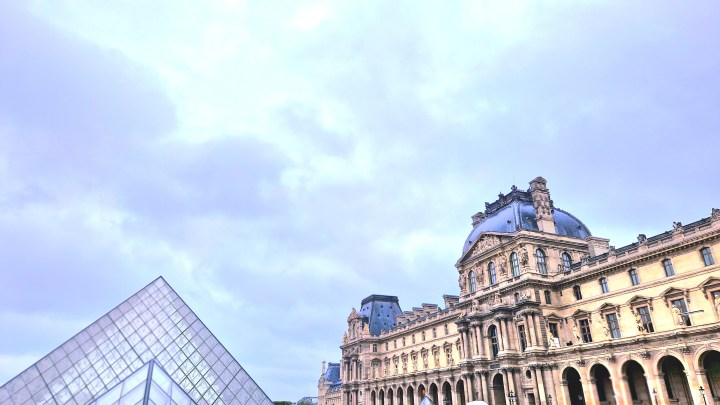
| The Louvre Pyramid on the Cour Napoléon with the Sully Pavilion and Denon Wing of the museum in the background | |
| Wikimedia | © OpenStreetMap | |
| Established | 10 August 1793; 232 years ago |
|---|---|
| Location | Musée du Louvre, 75001, Paris, France |
| Type | Art museum and historic site |
| Collection size | 615,797 in 2019[1] (35,000 on display)[2] |
| Visitors | 8.7 million (2024)[3]Ranked 1st nationallyRanked 1st globally |
| Director | Laurence des Cars |
| Curator | Marie-Laure de Rochebrune |
| Public transit access | Palais Royal–Musée du Louvre Louvre–Rivoli |
| Website | Official website |
The Louvre[a] or the Louvre Museum (French: Musée du Louvre [myze dy luvʁ] ⓘ), is a national art museum in Paris, France, and one of the most famous museums in the world. It is located on the Right Bank of the Seine in the city’s 1st arrondissement (district or ward) and home to some of the most canonical works of Western art, including the Mona Lisa, Venus de Milo, and Winged Victory. The museum is housed in the Louvre Palace, originally built in the late 12th to 13th century under Philip II. Remnants of the Medieval Louvre fortress are visible in the basement of the museum. Due to urban expansion, the fortress eventually lost its defensive function, and in 1546 Francis I converted it into the primary residence of the French kings.[6]
The building was redesigned and extended many times to form the present Louvre Palace. In 1682, Louis XIV chose the Palace of Versailles for his household, leaving the Louvre primarily as a place to display the royal collection, including, from 1692, a collection of ancient Greek and Roman sculpture.[7] In 1692, the building was occupied by the Académie des Inscriptions et Belles-Lettres and the Académie Royale de Peinture et de Sculpture, which in 1699 held the first of a series of salons. The Académie remained at the Louvre for 100 years.[8] During the French Revolution, the National Assembly decreed that the Louvre should be used as a museum to display the nation’s masterpieces. The palace and exhibition space was expanded in the 19th century and again in the 20th.
The museum opened on 10 August 1793 with an exhibition of 537 paintings, the majority of the works being royal and confiscated church property. Because of structural problems with the building, the museum was closed from 1796 until 1801. The collection was increased under Napoleon, after the Napoleonic looting of art in Europe, Egypt, and Syria, and the museum was renamed Musée Napoléon, but after Napoleon’s abdication, many works seized by his armies were returned to their original owners.[citation needed] The collection was further increased during the reigns of Louis XVIII and Charles X, and during the Second French Empire the museum gained 20,000 pieces. Holdings have grown steadily through donations and bequests since the Third Republic. The collection is divided among eight curatorial departments: Egyptian Antiquities; Near Eastern Antiquities; Greek, Etruscan, and Roman Antiquities; Islamic Art; Sculpture; Decorative Arts; Paintings; Prints and Drawings.
The Musée du Louvre contains approximately 500,000 objects[9] and displays 35,000 works of art in eight curatorial departments with more than 60,600 m2 (652,000 sq ft) dedicated to the permanent collection.[2] The Louvre exhibits sculptures, objets d’art, paintings, drawings, and archaeological finds. At any given point in time, approximately 38,000 objects from prehistory to the 21st century are being exhibited over an area of 72,735 m2 (782,910 sq ft), making it the largest museum in the world. It received 8.7 million visitors in 2024, ranking it as the most-visited art museum, and most-visited museum of any category, in the world.[10]
On 19 October 2025, burglars broke into the Galerie d’Apollon, located on the second floor and stole nine major pieces of jewellery from the crowns of France in a few minutes.[11] They used a construction platform left by the building to enter a window and leave with their booty.[12] The museum was closed for the day.
Location and visiting

The Louvre museum is located inside the Louvre Palace, in the center of Paris, adjacent to the Tuileries Gardens. The two nearest Métro stations are Louvre-Rivoli and Palais Royal-Musée du Louvre, the latter having a direct underground access to the Carrousel du Louvre commercial mall.[13]
Before the Grand Louvre overhaul of the late 1980s and 1990s, the Louvre had several street-level entrances, most of which are now permanently closed. Since 1993, the museum’s main entrance has been the underground space under the Louvre Pyramid, or Hall Napoléon, which can be accessed from the Pyramid itself, from the underground Carrousel du Louvre, or (for authorized visitors) from the passage Richelieu connecting to the nearby rue de Rivoli. A secondary entrance at the Porte des Lions, near the western end of the Denon Wing, was created in 1999 but is not permanently open.[14]
The museum’s entrance conditions have varied over time. Prior to the 1850s, artists and foreign visitors had privileged access. At the time of initial opening in 1793, the French Republican calendar had imposed ten-day “weeks” (French: décades), the first six days of which were reserved for visits by artists and foreigners and the last three for visits by the general public.[15]: 37 In the early 1800s, after the seven-day week had been reinstated, the general public had only four hours of museum access per week, between 2pm and 4pm on Saturdays and Sundays.[16]: 8 In 1824, a new regulation allowed public access only on Sundays and holidays; the other days the museum was open only to artists and foreigners, except for closure on Mondays.[15]: 39 That changed in 1855 when the museum became open to the public all days except Mondays.[15]: 40 It was free until 1922, when an entrance fee was introduced except on Sundays.
 FRANCE RESIDENCES

.jpg)